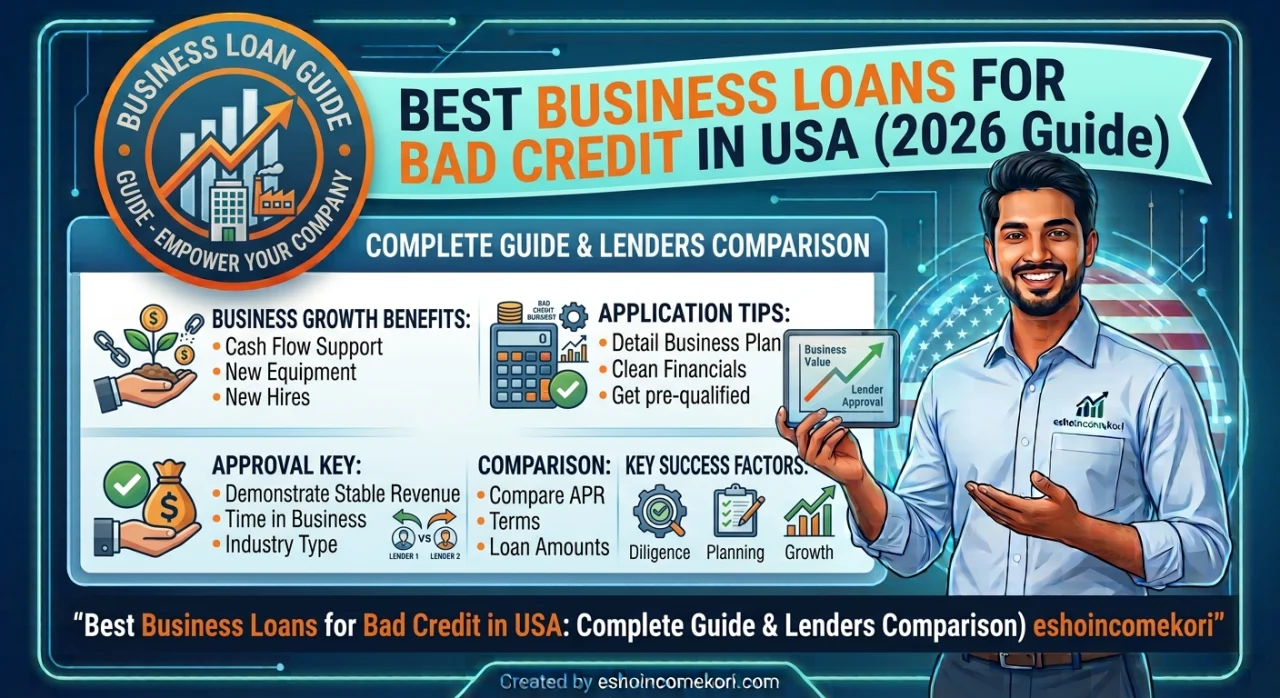
Best Business Loans for Bad Credit in USA: Complete Guide & Lenders Comparison
Compare the best small business loans for bad credit in the USA. Learn about lender minimum credit scores, factor rates, revenue qualifications, and fast funding strategies.
Discover Hook Intro
A low personal credit score (under 620) can feel like an insurmountable barrier when seeking working capital to purchase inventory, repair vital machinery, or meet payroll demands. Traditional commercial banks and national credit unions routinely reject up to 80% of small business loan applications if the primary business owner’s FICO score falls below prime thresholds. However, the modern fintech lending landscape in 2026 has fundamentally shifted the underwriting equation.
Alternative lenders and revenue-backed funding platforms weigh daily sales volume, bank statement health, unpaid B2B invoices, and business asset collateral far more heavily than personal credit history. Whether your business has a 500 FICO score or a limited credit history, securing $10,000 to $500,000+ in working capital is completely achievable when matching your business model with the correct financing structure. This comprehensive guide analyzes top-rated subprime lenders, breaks down borrowing costs, and reveals strategies to qualify without falling into high-cost predatory traps.
Quick Summary / Key Takeaways
Key Takeaways
Revenue Over Credit: Many alternative business lenders approve applications with FICO scores as low as 500 to 570, provided the business generates $10,000 to $30,000 in monthly sales.
Understanding Factor Rates: Subprime business loans often use factor rates (e.g., 1.15 to 1.45) rather than interest rates (APRs). A 1.20 factor rate on $50,000 means repaying $60,000 ($50,000 × 1.20).
Asset-Backed Funding is Cheaper: Equipment financing and invoice factoring carry lower costs than unsecured revenue loans because physical machinery or B2B receivables directly collateralize the debt.
Speed of Capital: Online bad-credit lenders can approve applications in minutes and wire funds into your business checking account in 24 to 48 hours.
Avoid Debt Spirals: Always verify your business’s gross profit margin before taking on daily or weekly automatic ACH remittances.
Table of Contents
-
Step-by-Step Guide to Getting Approved with a 500–600 Credit Score
-
Real-World Case Study: Overcoming Subprime Credit for Business Growth
Understanding Bad Credit Business Financing
Personal credit scores (FICO) reflect how an individual manages personal consumer debt (credit cards, mortgages, auto loans). However, when evaluating a commercial enterprise, alternative underwriters recognize that personal credit setbacks—like medical bills or past personal hardships—do not necessarily mean a business is unprofitable.
Personal Credit Score Classifications for Business Lending
-
Prime Credit (720–850): Qualifies for traditional bank loans, SBA 7(a) loans, and single-digit interest rates.
-
Near-Prime Credit (640–719): Qualifies for online term loans, lines of credit, and standard fintech rates.
-
Subprime / Bad Credit (500–639): Qualifies for revenue-based loans, merchant cash advances, equipment loans, and invoice factoring.
-
Deep Subprime (Below 500): Requires hard asset collateral, high-volume credit card receivables, or microloan community development funds.
Lenders specializing in bad credit replace personal credit risk checks with cash flow analysis. They connect directly to your business checking account via secure API connections (like Plaid) to verify monthly deposits, average daily balances, and non-sufficient funds (NSF) frequency.
Types of Business Loans Available for Poor Credit
Selecting the right loan type prevents unnecessary fee exposure and aligns repayment schedules with your incoming revenue cycle.
                      ┌─────────────────────────────────────────┐
                      │    Subprime Business Financing Types    │
                      └────────────────────┬────────────────────┘
                                           │
         ┌─────────────────────────────────┼─────────────────────────────────┐
         ▼                                 ▼                                 ▼
┌──────────────────┐              ┌──────────────────┐              ┌──────────────────┐
│ Asset-Backed     │              │ Revenue-Based    │              │ Working Capital  │
│ Financing        │              │ Financing / MCA  │              │ Lines of Credit  │
└────────┬─────────┘              └────────┬─────────┘              └────────┬─────────┘
         │                                 │                                 │
 ┌───────┴───────┐                 ┌───────┴───────┐                 ┌───────┴───────┐
 │ Equipment &   │                 │ Daily/Weekly  │                 │ Flexible      │
 │ Invoice       │                 │ Repayment     │                 │ Revolving     │
 │ Factoring     │                 │ via Sales %   │                 │ Draws         │
 └───────────────┘                 └───────────────┘                 └───────────────┘
1. Equipment Financing
If your business needs physical machinery, commercial vehicles, kitchen gear, or specialized tools, equipment financing uses the purchased equipment as direct collateral.
-
Minimum Credit Score: 520+
-
Why it Works: Because the lender can repossess and liquidate the physical equipment upon default, personal credit score is a secondary underwriting consideration.
2. Invoice Factoring & Invoice Financing
B2B businesses that sell to corporate or government clients on Net-30, Net-60, or Net-90 payment terms can sell unpaid invoices to a factoring company for an immediate 80% to 90% cash advance.
-
Minimum Credit Score: 500+ (or no minimum score check)
-
Why it Works: Approval rests on the creditworthiness and financial health of your customers, not your personal credit history.
3. Revenue-Based Financing & Merchant Cash Advances (MCAs)
Lenders provide a lump-sum cash advance in exchange for a fixed percentage of your future credit card sales or daily bank deposits until a total agreed amount (principal + factor fee) is paid off.
-
Minimum Credit Score: 500–570
-
Why it Works: Payments flex alongside your daily sales volume—higher sales speed up repayment, while slower sales automatically reduce the daily dollar amount deducted.
4. Subprime Business Lines of Credit
A revolving credit line allows you to draw funds up to an approved limit, pay interest or fees only on the drawn balance, and reuse credit as you repay.
-
Minimum Credit Score: 600+
-
Why it Works: Provides flexible emergency working capital for recurring needs like inventory replenishments or seasonal payroll gaps.
Top Bad-Credit Business Lenders & Platforms Compared
1. Fundible
-
Best Overall for Low Credit
-
Minimum Credit Score: 500
-
Minimum Qualifications: 6 months in business, $100,000 annual revenue
-
Overview: Fundible offers high approval flexibility for borrowers with subprime credit. They provide short-term term loans, equipment financing, and revenue advances up to $500,000 with 24-hour funding availability.
2. Fora Financial
-
Best for Fast Approval & High Loan Amounts
-
Minimum Credit Score: 570
-
Minimum Qualifications: 6 months in business, $20,000 monthly revenue ($240,000/year)
-
Overview: Fora Financial specializes in funding growth capital without rigid collateral requirements. They offer financing up to $1.5 million with flexible repayment terms.
3. Fundbox
-
Best Revolving Line of Credit
-
Minimum Credit Score: 600
-
Minimum Qualifications: 3 months in business, $30,000 annual revenue
-
Overview: Ideal for newer businesses with fair credit. Fundbox connects seamlessly to accounting software (QuickBooks, FreshBooks) or bank accounts, approving lines of credit up to $250,000 in minutes.
4. Lendio
-
Best Marketplace for Comparing Offers
-
Minimum Credit Score: 500+ (varies across 75+ lender network)
-
Minimum Qualifications: 6 months in business, $10,000 monthly revenue
-
Overview: Lendio is a business loan marketplace that matches your business profile against dozens of specialized alternative lenders with a single soft-credit-check application.
5. OnDeck
-
Best for Fast Working Capital
-
Minimum Credit Score: 620
-
Minimum Qualifications: 1 year in business, $100,000 annual revenue
-
Overview: OnDeck provides automated term loans and lines of credit up to $250,000 with same-day funding options for qualified applicants.
Factor Rates vs. APR: Calculating Your True Cost of Capital
Subprime and revenue-based business loans rarely quote standard Annual Percentage Rates (APRs). Instead, they use factor rates expressed as a decimal (typically ranging from 1.10 to 1.45).
Understanding the Factor Rate Math
Example Calculation:
-
Borrowed Principal: $40,000
-
Quoted Factor Rate: 1.25
-
Repayment Calculation:
$$\text{Total Repayment} = \$40,000 \times 1.25 = \mathbf{\$50,000}$$ -
Total Fee Paid: $\mathbf{\$10,000}$
Unlike traditional loans where making early payments reduces overall interest charges, a factor rate locks in the total fee upfront. If you borrow $40,000 at a 1.25 factor rate, you will repay $50,000 whether you pay it off in 3 months or 12 months (unless the lender explicitly offers an early payoff discount).
Warning: Converting Factor Rate to Approximate Annualized Rate
If a $40,000 loan with a $10,000 fee (factor 1.25) is repaid via daily ACH withdrawals over a 6-month term, the effective annualized rate (APR equivalent) can exceed 40% to 60%. Always calculate whether your business profit margins can support daily automated withdrawals.
Step-by-Step Guide to Getting Approved with a 500–600 Credit Score
Executing a targeted application process increases your approval odds while keeping borrowing costs down.
-
Clean Up Bank Statement Signals: For 60 days prior to applying, eliminate non-sufficient funds (NSF) charges, keep daily ending balances consistently positive, and avoid transferring money in and out of personal accounts.
-
Organize B2B Invoices & Financial Statements: If applying for factoring or equipment loans, compile your current Accounts Receivable (A/R) aging report and equipment purchase orders.
-
Use Marketplace Soft-Pulls First: Apply through matching networks like Lendio or Biz2Credit to check pre-qualification offers without triggering a hard credit inquiry that lowers your credit score.
-
Choose Weekly Repayments Over Daily Repayments: If offered a choice, opt for weekly ACH debits rather than daily debits to maintain cash flow buffer flexibility during slower business days.
-
Pledge Commercial Assets if Possible: Offering a commercial truck, real estate, or high-value equipment lowers lender risk, drastically cutting your factor rate.
Lender Comparison Matrix
| Lender / Product | Min. Credit Score | Min. Monthly Revenue | Funding Speed | Primary Advantage |
| Fundible | 500 | ~$8,300 ($100k/yr) | 24 Hours | Lowest credit score threshold |
| Fora Financial | 570 | $20,000 | 24–48 Hours | High loan amounts up to $1.5M |
| Fundbox | 600 | ~$2,500 ($30k/yr) | 1–2 Days | Flexible lines of credit for newer businesses |
| Lendio | 500+ | $10,000 | 24–72 Hours | Compares offers across 75+ subprime lenders |
| OnDeck | 620 | ~$8,300 ($100k/yr) | Same Day | Fastest automated loan funding |
| Equipment Financing | 520 | Varies by asset | 2–5 Days | Asset serves as direct collateral |
| Invoice Factoring | 500 / None | Varies by A/R volume | 24–48 Hours | Underwritten on client creditworthiness |
Real-World Case Study: Overcoming Subprime Credit for Business Growth
Case Study: Restaurant Equipment Replacement & Capital Expansion
Business Profile: Apex Bistro, an independent restaurant, suffered a major commercial freezer breakdown right before peak summer season.
-
Owner’s Personal Credit Score: 540 (due to past medical debt collections)
-
Annual Business Revenue: $480,000 ($40,000/month average)
-
Traditional Bank Result: Rejected outright due to FICO score falling below the 680 bank cutoff.
Financing Solution Executed:
-
Equipment Financing: The owner secured $18,000 for a commercial freezer unit using the equipment itself as primary collateral at a 12% interest rate over a 36-month term.
-
Short-Term Revenue Advance: To stock up on summer bulk inventory, the owner secured a $25,000 revenue advance at a 1.22 factor rate ($30,500 total repayment) over a 6-month term with weekly ACH payments.
Financial Outcome:
-
Weekly Revenue Advance Payment: $1,173 per week
-
Summer Revenue Boost: Access to bulk inventory enabled a $15,000 monthly sales increase throughout peak season ($90,000 total added revenue).
-
Net Profit: After paying $5,500 in factor fees and $1,173 weekly remittances, the business generated $32,000 in net profit that would have been completely lost without working capital.
“When personal credit is damaged, stop trying to borrow against your past consumer behavior. Borrow against your business’s current bank statements and asset equity.”
— Small Business Capital Consultant
Pros & Cons of Subprime Business Financing
Pros
-
High Approval Rates: Underwriting focuses on monthly gross revenue and cash flow health rather than FICO history.
-
Rapid Speed to Capital: Approval in hours and funding wired directly to your checking account within 24 to 48 hours.
-
No Asset Collateral Options: Unsecured revenue loans and MCAs do not require pledging real estate or personal assets.
-
Rebuilds Business Credit: Timely payments to subprime lenders reporting to business credit bureaus (Experian Commercial, PayNet) establish strong corporate credit files.
Cons
-
Higher Cost of Capital: Factor rates and subprime fees mean paying significantly more than traditional bank APRs.
-
Daily / Weekly Cash Flow Pressure: Frequent automatic ACH debits can create cash flow strain during slow business weeks.
-
Shorter Repayment Windows: Most subprime term loans and advances must be fully repaid within 3 to 24 months.
Google FAQ Schema Section
JSON
{
  "@context": "https://schema.org",
  "@type": "FAQPage",
  "mainEntity": [
    {
      "@type": "Question",
      "name": "Can I get a business loan with a 500 credit score?",
      "acceptedAnswer": {
        "@type": "Answer",
        "text": "Yes. Lenders like Fundible, Lendio, and specialized invoice factoring platforms approve applicants with credit scores as low as 500, provided the business demonstrates consistent monthly revenue ($10,000+) and healthy bank statement activity."
      }
    },
    {
      "@type": "Question",
      "name": "What is the easiest business loan to get with bad credit?",
      "acceptedAnswer": {
        "@type": "Answer",
        "text": "Invoice factoring and merchant cash advances (MCAs) are the easiest to qualify for because underwriting relies heavily on customer invoice reliability or daily credit card deposit volume rather than the business owner's credit score."
      }
    },
    {
      "@type": "Question",
      "name": "How does a factor rate work on a business loan?",
      "acceptedAnswer": {
        "@type": "Answer",
        "text": "A factor rate is a decimal multiplier (e.g., 1.20) used to calculate total repayment amount. Multiplying the borrowed principal by the factor rate gives your total cost. For example, $20,000 borrowed at a 1.20 factor rate equals $24,000 total repayment."
      }
    },
    {
      "@type": "Question",
      "name": "Do alternative business lenders perform hard credit checks?",
      "acceptedAnswer": {
        "@type": "Answer",
        "text": "Most alternative lenders and loan marketplaces use soft credit checks during the initial pre-qualification phase, which does not impact your credit score. A hard credit check is typically only conducted upon final contract sign-off."
      }
    },
    {
      "@type": "Question",
      "name": "Can I get an SBA loan with a low credit score?",
      "acceptedAnswer": {
        "@type": "Answer",
        "text": "SBA 7(a) loans usually require a minimum credit score of 650 to 680. However, SBA Microloans (up to $50,000) offered through local non-profit community lenders have far more flexible credit requirements."
      }
    },
    {
      "@type": "Question",
      "name": "How much monthly revenue do I need for a subprime business loan?",
      "acceptedAnswer": {
        "@type": "Answer",
        "text": "Most alternative lenders require a minimum monthly gross revenue between $10,000 and $20,000 ($120,000 to $240,000 annually) verified via 3 to 6 months of official business bank statements."
      }
    },
    {
      "@type": "Question",
      "name": "How fast can I get funded with a bad credit business loan?",
      "acceptedAnswer": {
        "@type": "Answer",
        "text": "Fintech and online subprime lenders offer rapid turnarounds, often approving applications within 2 to 4 hours and depositing funds into your account within 24 to 48 hours."
      }
    },
    {
      "@type": "Question",
      "name": "Will a bad credit business loan help build my credit?",
      "acceptedAnswer": {
        "@type": "Answer",
        "text": "If the lender reports payment activity to major business credit bureaus like PayNet, Experian Commercial, or Dun & Bradstreet, making consistent on-time repayments will build your corporate credit profile."
      }
    },
    {
      "@type": "Question",
      "name": "What is the difference between revenue-based financing and a business loan?",
      "acceptedAnswer": {
        "@type": "Answer",
        "text": "Traditional loans feature fixed monthly interest and fixed principal payments over set terms. Revenue-based financing provides a cash advance repaid via daily or weekly percentages of sales, meaning repayments adjust based on revenue shifts."
      }
    },
    {
      "@type": "Question",
      "name": "What documents are needed to apply for a subprime business loan?",
      "acceptedAnswer": {
        "@type": "Answer",
        "text": "Standard requirements include 3 to 6 months of recent business bank statements, a valid driver's license, business tax EIN, and corporate registration documents."
      }
    }
  ]
}
- আরো পড়ুন
- NID Correction Online Rejection Reasons & How to Appeal Successfully
- Facebook Status Guide: From Posting Updates to Checking Server Health ফেসবুক স্ট্যাটাস: শেয়ারিং ও সার্ভার স্ট্যাটাস গাইড
- গ্রাফিক Design ডিজাইন কোর্স | ১২হাজার টাকার কোর্স ফ্রি ডাউনলোড করুন
- অর্থ লেনদেনের সহজ ও নিরাপদ পদ্ধতি, স্ক্রিল Skril .
- ipl আইপিএল লাইভ ভিডিও ২০২২ | আইপিএল লাইভ স্কোর 2022
Verdict & Final Recommendation
A bad personal credit score does not have to stall your business’s growth or cause cash flow bottlenecks. By shifting your focus toward cash-flow-backed, asset-backed, or revenue-based financing, you can secure the working capital needed to run operations smoothly.
Action Plan for Business Owners:
-
Analyze Cash Flow Margins: Ensure your gross margins can easily support daily or weekly factor fee remittances before signing contracts.
-
Gather Bank Statements: Download 3 to 6 months of complete business checking PDF statements showing steady deposit volume.
-
Compare Multiple Marketplace Offers: Submit a soft-check application on marketplace networks like Lendio to evaluate options without lowering your credit score.
-
Prioritize Asset-Backed Loans: If buying equipment or holding unpaid invoices, choose equipment financing or factoring for substantially lower borrowing costs.
Internal Linking Architecture
Maintain structural cross-linking across your financial portal:
-
Primary Anchor: Link to Best Working Capital Loans for Small Business within the Subprime Lines of Credit section to help businesses build emergency reserves.
-
Secondary Anchor: Connect to How to Calculate Factor Rates vs APR in the Cost of Capital section to give readers deep financial math tools.
-
Related Guide Anchor: Insert a link to Equipment Financing Guide for Commercial Assets in the Equipment Loans section.
-
Tool Anchor: Direct users to our interactive Business Loan Cost & Factor Rate Calculator in the Factor Rates section.
About the Author