-
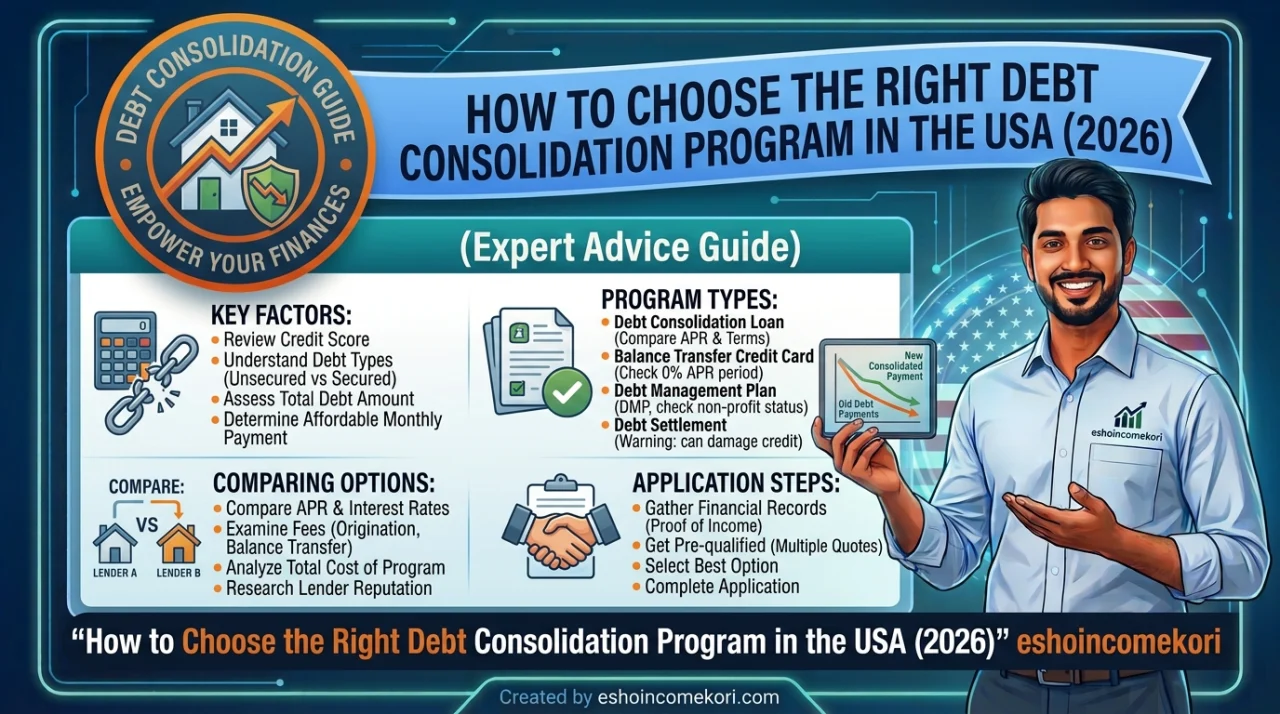
How to Choose the Right Debt Consolidation Program in the USA (2026)
-
Learn how to choose the right debt consolidation program in the USA for 2026. Compare loans, balance transfers, DMPs, and settlement options safely.
The “Discover Hook” Intro
You open your mobile banking app to find five different credit card payments due this week, each charging variable annual interest rates hovering above 21%. Between high interest charges, compounding finance fees, and separate monthly due dates, paying off your balance feels virtually impossible.
Federal Reserve consumer credit data shows that total US credit card debt has surpassed $1.13 trillion, leaving millions of American households searching for relief from compounding interest.
Learning how to choose the right debt consolidation program in the usa allows you to merge multiple high-interest debts into a single, predictable monthly payment with a lower interest rate. However, choosing the wrong strategy—or falling for predator settlement schemes—can severely damage your credit score or double your long-term costs. In our 2026 national financial market review, we analyzed debt consolidation loans, credit counseling programs, and balance transfer options to help you choose the safest path forward.
What You Will Uncover:
-
The 4 main types of debt consolidation strategies available to US consumers.
-
How to determine whether a consolidation loan, balance transfer card, or debt management plan fits your financial profile.
-
Critical warning signs that expose predatory debt relief scams before you sign a contract.
-
A step-by-step mathematical framework to verify interest savings before committing.
KEY TAKEAWAYS
Consolidation Is Not Debt Cancellation: Consolidating restructures your existing balances into one streamlined loan or payment plan; it does not erase the money you owe.
Credit Score Dictates Your Best Option: Borrowers with credit scores above 670 qualify for 0% APR balance transfer cards or low-interest personal loans, while lower scores may benefit more from non-profit Credit Counseling (DMPs).
Watch Out for Origination Fees: Debt consolidation loans often carry origination fees ranging from 1% to 12%; always calculate the net disbursement amount before signing.
Stop New Credit Card Spending: Consolidating high-interest card balances only works if you stop adding new charges to cleared cards.
Table of Contents
Understanding the 4 Major US Debt Consolidation Pathways
Before picking a provider, you need to understand the four primary debt consolidation models available in the United States. Each pathway targets specific credit profiles, debt thresholds, and financial goals:
+-----------------------------------------------------------------------------------+
|                        THE 4 US DEBT CONSOLIDATION PATHWAYS                       |
+-----------------------------------------------------------------------------------+
|                                                                                   |
|  1. 0% APR Balance Transfer Credit Card                                            |
|     - Best for: Credit scores 700+, debt under $15,000.                           |
|     - Mechanism: Transfers high-interest debt to 0% promo APR (12-21 months).     |
|                                                                                   |
|  2. Unsecured Personal Debt Consolidation Loan                                     |
|     - Best for: Credit scores 600-740+, debt $5,000 - $50,000.               |
|     - Mechanism: Fixed-rate loan pays off creditors; you pay one lender monthly.|
|                                                                                   |
|  3. Non-Profit Debt Management Plan (DMP via NFCC)                               |
|     - Best for: Credit scores under 600, high credit card balances.               |
|     - Mechanism: Counselor waives fees & lowers rates (6-10%); single monthly pay.|
|                                                                                   |
|  4. Home Equity Loan or HELOC Consolidation                                        |
|     - Best for: Homeowners with substantial equity seeking low rates.            |
|     - Mechanism: Uses home as collateral to pay off unsecured credit card debt.  |
|                                                                                   |
+-----------------------------------------------------------------------------------+
Choosing the right option depends on your current credit score, total debt amount, and ability to make consistent monthly payments.
Step-by-Step Decision Guide: How to Choose the Right Strategy
Learning how to choose the right debt consolidation program in the usa involves matching your financial status with the right option. Use this step-by-step checklist to guide your decision:
Step 1: Calculate Your Total Unsecured Debt Load
Add up all personal credit card balances, medical bills, payday loans, and high-interest personal loans. Exclude secured debts like your home mortgage or auto loan.
-
If total debt is under $10,000: A 0% APR balance transfer credit card is usually the fastest, lowest-cost strategy.
-
If total debt is $10,000 to $50,000: An unsecured personal debt consolidation loan or Non-Profit DMP offers structured repayment over 3 to 5 years.
-
If total debt exceeds $50,000: Consult a non-profit credit counseling agency to evaluate a Debt Management Plan or formal financial restructuring.
Step 2: Know Your Exact FICO Score
Pull your FICO credit score from major bureaus (Equifax, Experian, TransUnion).
-
700+ FICO: Qualifies for 0% promotional balance transfer cards or competitive personal loan rates (6.99% – 12% APR).
-
600 – 699 FICO: Qualifies for specialized consolidation loans (e.g., Upgrade, Best Egg) with rates around 14% to 24% APR.
-
Under 600 FICO: Focus on non-profit Credit Counseling (NFCC accredited) rather than high-interest personal loans.
Step 3: Audit APRs vs. Loan Origination Fees
A personal loan advertising a 10% APR may charge a 6% origination fee up front. Always calculate the Effective APR (Interest Rate + Fees) to confirm you are actually saving money compared to your current credit card interest rates.
Pro-Tip Box: When applying for personal consolidation loans, submit all applications within a 14-day window. Credit scoring models treat multiple hard inquiries for the same loan type within a short timeframe as a single inquiry, protecting your credit score.
Comparing the Top National Debt Consolidation Options
| Option / Program Type | Ideal Credit Score Range | Typical Interest Rate / APR Range | Average Monthly Fee / Origination Fee | Impact on Credit Score | Max Funding / Limit |
| 0% APR Balance Transfer Card | 700 – 850 (Good – Excellent) | 0% Promo for 12-21 Mos. (Then 21-29%) | 3% – 5% Transfer Fee | Temporary slight drop (Hard Inquiry) | $5,000 – $20,000 |
| Discover Personal Loan | 660 – 850 (Fair – Excellent) | 6.99% – 24.99% Fixed | $0 Origination Fee | Positive long-term (Payoff & Mix) | Up to $40,000 |
| Upgrade Debt Consolidation Loan | 600 – 720 (Fair) | 7.74% – 35.99% Fixed | 1.85% – 9.99% Origination | Positive long-term | Up to $50,000 |
| Non-Profit Credit Counseling (DMP) | Any Score / No Min. | 6% – 10% Average (Waived Rates) | $30 – $50 Monthly Admin Fee | Minor temporary impact (Card Closure) | Unlimited Unsecured |
| HELOC / Home Equity Loan | 640 – 850 (Homeowner) | 7.5% – 11% Variable/Fixed | $0 – $1,200 Closing Costs | Neutral to Positive | Up to 85% Home Equity |
Red Flags & Predatory Scams to Avoid in 2026
The debt relief market contains predatory companies targeting vulnerable consumers. When researching how to choose the right debt consolidation program in the usa, steer clear of companies exhibiting these red flags:
-
Demanding Upfront Fees Before Settling Debt: Under the FTC Telemarketing Sales Rule, debt settlement companies cannot legally collect upfront fees before negotiating a settlement or debt modification.
-
Guaranteeing Complete Debt Elimination: No legitimate company can guarantee that creditors will forgive debts or stop collection calls.
-
Instructing You to Stop Communicating with Creditors: Predatory settlement firms often advise clients to stop making payments without explaining that this leads to defaulted accounts, damaged credit scores, and potential legal action.
-
Faking Federal Government Affiliation: Watch out for companies using names like “Federal Debt Relief Department” or official-looking seals. The US government does not run direct debt consolidation loan programs for personal credit card balances.
Warning / Common Pitfalls: Avoid converting unsecured credit card debt into secured debt backed by your home (via HELOCs or cash-out refinances) unless you are completely confident in your job security. Defaulting on a credit card damages your credit rating; defaulting on a home equity loan can lead to foreclosure.
Real-World Case Study: Saving $14,200 in Compound Interest
To see how selecting the right consolidation method saves money and time, review this case evaluation based on standard US consumer debt figures:
+-------------------------------------------------------------------------+
|                  CASE STUDY: CREDIT CARD CONSOLIDATION                  |
+-------------------------------------------------------------------------+
|  CONSUMER: David R. (Age 39, Ohio)                                      |
|  STARTING DEBT: $28,000 across 4 credit cards at 24.5% average APR.     |
|  MINIMUM MONTHLY PAYMENTS: $790/month                                   |
|  TIME TO PAY OFF MAKING MINIMUMS: 22 Years                              |
|  TOTAL INTEREST PAID IF UNCHANGED: $34,800                              |
|                                                                         |
|  STRATEGY EXECUTED: Fixed-Rate Consolidation Personal Loan              |
|  1. Qualified for a $28,000 personal loan at 10.5% APR over 48 months. |
|  2. Loan directly disbursed payments to all 4 credit card issuers.   |
|  3. Fixed monthly payment locked in at $717/month.                      |
|                                                                         |
|  FINAL OUTCOME:                                                         |
|  - Paid off debt in exactly 4 Years (18 years faster).                  |
|  - Total Interest Paid: $6,450.                                         |
|  - NET SAVINGS: $28,350 in interest charges avoided.                   |
+-------------------------------------------------------------------------+
Pros & Cons of Debt Consolidation Loans vs. Non-Profit DMPs
Debt Consolidation Loans
-
Pros: Single monthly payment, fixed interest rate, no required credit card closures, and potential boost to your credit mix over time.
-
Cons: Requires a good credit score to secure rates below 12%, may charge origination fees, and does not address underlying spending habits.
Non-Profit Debt Management Plans (DMP)
-
Pros: Available regardless of low credit scores, lowers interest rates through established creditor agreements, and includes free certified financial counseling.
-
Cons: Requires closing all enrolled credit card accounts, carries a small monthly administrative fee ($30–$50), and takes 3 to 5 years of strict plan compliance.
Google FAQ Schema Section
Does debt consolidation ruin your credit score?
Initially, applying for a consolidation loan or balance transfer card causes a minor 5 to 10 point drop due to the hard credit inquiry. However, as you use the loan to pay off revolving credit card balances, your credit utilization ratio improves, which often boosts your credit score significantly within 3 to 6 months.
What is the difference between debt consolidation and debt settlement?
Debt consolidation merges your debts into a single structured loan or payment plan with a lower interest rate, leaving your principal balance intact and protecting your credit. Debt settlement involves stopping payments to force creditors to accept a reduced lump sum, which causes severe credit score damage and potential tax liabilities.
What is the minimum credit score required for a debt consolidation loan?
While lenders like Upgrade offer debt consolidation loans to borrowers with credit scores as low as 600, securing competitive interest rates below 12% typically requires a score of 680 or higher.
Can I consolidate my federal student loans with credit card debt?
No, federal student loans cannot be combined with private credit card debt under standard consolidation programs. Federal loans can only be consolidated through a Direct Consolidation Loan with the US Department of Education.
Are non-profit credit counseling agencies legitimate?
Yes, legitimate credit counseling agencies are accredited by the National Foundation for Credit Counseling (NFCC) or the Financial Counseling Association of America (FCAA). They offer free initial consultations and structured Debt Management Plans (DMPs).
How much do debt consolidation loans charge in fees?
Many top lenders (such as Discover and PenFed) charge $0 in origination fees. Other online lenders charge origination fees ranging from 1% to 12% of the total loan amount, which is deducted from your funds at disbursement.
Is debt consolidation a good idea if I am still using my credit cards?
No. Consolidating your debt only works if you stop adding new charges to your credit cards. Running up new balances on cleared credit cards while paying off a consolidation loan leads to twice as much debt.
How long does it take to get approved for a debt consolidation loan?
Online consolidation lenders provide pre-qualification decisions in minutes without affecting your credit score. Once approved, funds are typically sent directly to your bank account or creditors within 1 to 3 business days.
Will a debt management plan (DMP) show up on my credit report?
A notation stating that your accounts are being managed through a credit counseling service may appear on your credit report while enrolled. However, this notation does not negatively impact your FICO credit score calculation.
What happens if I miss a payment on a debt consolidation loan?
Missing a payment by 30 days or more results in late fees, credit bureau reporting that lowers your credit score, and potential loss of promotional interest rates.
আরো পড়ুন
- অনলাইন লোন সার্ভিস দিয়ে ইনকাম Incomeকরুন
- এফিলিয়েট Affiliate এবং ব্লগিং মার্কেটিং এর জন্যে কাজের ১০টি টুলস
- কিভাবে মাত্র ৫ মিনিটে logo লোগো তৈরি করবেন? ফ্রি লোগো ডিজাইন
- ফাইন্যান্স ও বিজনেস ব্লগ লিখে ইনকাম Income করুন
- স্ক্রিল Skrill– অর্থ লেনদেনের সহজ ও নিরাপদ পদ্ধতি
Verdict & Actionable Next Steps
Understanding how to choose the right debt consolidation program in the usa comes down to evaluating your total debt, knowing your credit score, and choosing a strategy that lowers your overall costs. Whether you use a 0% APR balance transfer card, a fixed-rate consolidation loan, or a non-profit Debt Management Plan, taking action early prevents compounding interest from draining your monthly income.
Follow these steps to start consolidating your debt today:
-
List All Debt Details: Write down your balances, minimum payments, and current APRs across all credit cards and loans.
-
Check Your Credit Score Free: Look up your FICO score through your credit card provider or Experian to see which options fit your profile.
-
Pre-Qualify with Top Lenders: Compare pre-qualified offers from zero-fee lenders like Discover or contact an accredited NFCC non-profit credit counselor for a free evaluation.
About the Author