


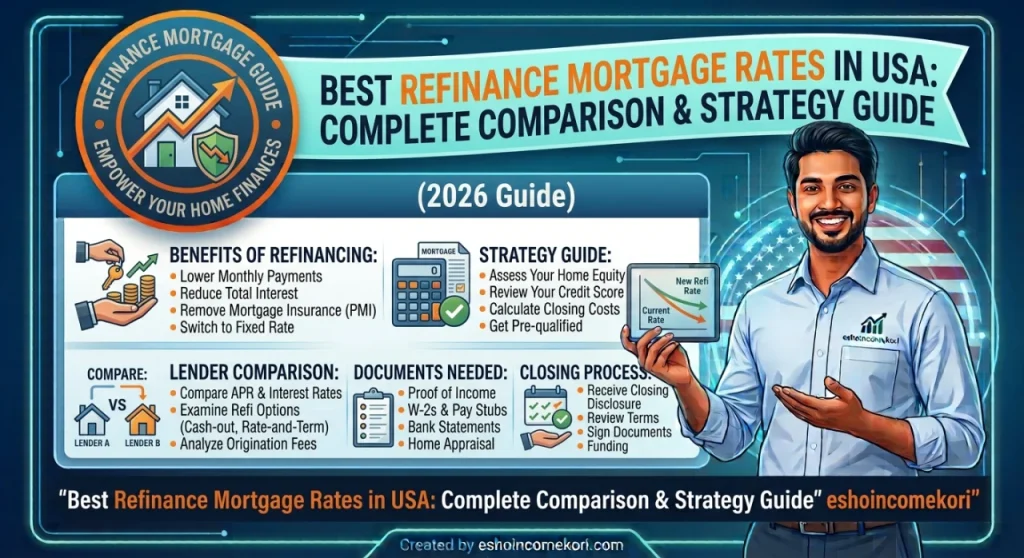
Best Refinance Mortgage Rates in USA: Complete Comparison & Strategy Guide
Compare today’s best refinance mortgage rates in the USA. Discover national average rates, top mortgage lenders, breakeven formulas, and strategies to save thousands.
Discover Hook Intro
If you locked in a mortgage when interest rates peaked above 7.5% or 8%, staying on autopilot could be costing you thousands of dollars every year. Mortgage refinance interest rates fluctuate daily based on Treasury yields, Federal Reserve monetary policies, and macroeconomic shifts. For homeowners sitting on substantial home equity, refinancing isn’t just about snagging a lower interest rate—it’s a high-leverage move to consolidate high-interest debt, eliminate Private Mortgage Insurance (PMI), or compress a 30-year amortization schedule into 15 fast-track years.
Navigating the mortgage refinance market requires looking beyond headline interest rates. Annual Percentage Rates (APRs), discount points, lender processing fees, and equity requirements dictate the true net benefit of refinancing. This guide delivers a comprehensive breakdown of national average refinance rates, side-by-side lender comparisons, breakeven calculations, and actionable strategies to help you secure the best rate possible.
Quick Summary / Key Takeaways
Key Takeaways
Current Rate Landscape: 30-year fixed refinance rates hover around 6.83% – 6.90% APR, while 15-year fixed refinance rates average 6.16% – 6.26% APR.
The 1% Rule Myth: You don’t need a 1% drop in interest rates for refinancing to make sense; a 0.50% to 0.75% reduction can save tens of thousands over the life of a typical $400,000 loan balance.
Breakeven Point is Critical: Divide total closing costs (typically 2% to 5% of the loan amount) by your monthly savings to determine how long you must stay in the home to profit.
Credit & Equity Matter: Homeowners with a 740+ FICO score and at least 20% home equity (80% LTV or lower) qualify for the lowest rates and bypass mandatory PMI requirements.
Government Options: VA IRRRL and FHA Streamline refinances offer streamlined underwriting with minimal paperwork and no mandatory home appraisals for eligible borrowers.
Table of Contents
Understanding Current Refinance Mortgage Rates
Refinance mortgage rates represent the interest charged by lenders to replace an existing mortgage with a brand-new loan contract. These rates move continuously in response to the 10-year U.S. Treasury bond yield, inflation data, and Federal Reserve benchmark decisions.
National Average Refinance Rates Snapshot
-
30-Year Fixed Refinance: Average interest rate sits around 6.83%, with average APR at 6.90%. Offers the lowest monthly payment by spreading amortization across 360 months.
-
15-Year Fixed Refinance: Average interest rate sits around 6.16%, with average APR at 6.26%. Features higher monthly payments but yields massive lifetime interest savings due to a faster amortization schedule.
-
VA Streamline Refinance (IRRRL): Average rates hover around 6.39% APR for eligible active-duty service members and veterans.
-
FHA Streamline Refinance: Average rates average 6.61% APR, ideal for borrowers with lower credit scores or higher loan-to-value ratios.
-
5/1 Adjustable-Rate Mortgage (ARM) Refinance: Starting rates average 6.25% – 6.67%, providing a fixed rate for the first 5 years before adjusting annually.
Pro-Tip: Interest Rate vs. APR
Always evaluate the Annual Percentage Rate (APR) rather than the nominal interest rate. The interest rate determines your base monthly payment, but the APR incorporates origination fees, discount points, processing costs, and broker fees—revealing the true annual cost of borrowing.
Types of Refinance Loans: Which One Is Right for You?
Selecting the correct refinance structure depends entirely on your financial goals—whether that is lowering monthly cash outlay, paying off your home early, or liquidating built-up equity.
                  ┌─────────────────────────────────────────┐
                  │       Mortgage Refinance Options        │
                  └────────────────────┬────────────────────┘
                                       │
         ┌─────────────────────────────┼─────────────────────────────┐
         ▼                             ▼                             ▼
┌──────────────────┐          ┌──────────────────┐          ┌──────────────────┐
│  Rate-and-Term   │          │     Cash-Out     │          │    Government    │
│    Refinance     │          │    Refinance     │          │    Streamline    │
└────────┬─────────┘          └────────┬─────────┘          └────────┬─────────┘
         │                             │                             │
 ┌───────┴───────┐             ┌───────┴───────┐             ┌───────┴───────┐
 │ Reduces Rate  │             │ Liquidates    │             │ Minimal Paper │
 │ or Changes    │             │ Home Equity   │             │ Work / No     │
 │ Term Duration │             │ for Cash      │             │ Appraisal     │
 └───────────────┘             └───────────────┘             └───────────────┘
1. Rate-and-Term Refinance
A Rate-and-Term refinance changes your interest rate, loan duration (e.g., switching from 30 years to 15 years), or both, without changing the principal balance beyond rolling in closing costs.
-
Best For: Homeowners aiming to reduce monthly payments or accelerate home payoff.
2. Cash-Out Refinance
A Cash-Out refinance replaces your current mortgage with a larger loan balance, allowing you to take the difference in lump-sum cash. Lenders typically limit the total loan balance to 80% of your home’s appraised value.
-
Best For: High-interest debt consolidation, major home remodeling, or funding primary repairs that boost property value.
3. Streamline Refinance (FHA & VA)
Designed for existing FHA or VA loan holders, streamline programs reduce underwriting hurdles. They frequently skip home appraisals, income verification, and comprehensive credit re-evaluations.
-
Best For: Borrowers looking for quick approvals with minimal documentation and reduced closing costs.
Warning: Cash-Out Refinance Risks
Cash-out refinancing converts unsecured consumer debt into secured mortgage debt against your residence. Defaulting on a cash-out refinance puts your home at direct risk of foreclosure.
Top Refinance Mortgage Lenders Compared
Selecting the right lender is crucial to securing optimal terms and a smooth closing process.
1. Rocket Mortgage
-
Best Overall for Digital Experience
-
Minimum Credit Score: 620
-
Key Features: Fully automated online loan submission, rapid pre-approvals, and wide availability across all 50 states.
2. Optimum First Mortgage
-
Best for Competitive Fixed Rates
-
Minimum Credit Score: 620
-
Key Features: Aggressive rate quotes on 30-year fixed refinances and customized lender credit structures.
3. Tomo Mortgage
-
Best for Low Closing Costs
-
Minimum Credit Score: 620
-
Key Features: Zero-lender-fee options and competitive APR pricing structures for qualified borrowers.
4. Navy Federal Credit Union
-
Best for Military & Veterans
-
Minimum Credit Score: No minimum specified for qualifying VA products
-
Key Features: Outstanding VA IRRRL terms, competitive interest rates, and no origination fees on select loan programs.
5. Better Mortgage
-
Best for Zero Lender Fees
-
Minimum Credit Score: 620
-
Key Features: Charges 0 origination fees or lender commissions, backed by a 100% digital platform.
Step-by-Step Refinance Process & Breakeven Calculation
Before applying, you must verify that your monthly payment savings exceed the upfront closing costs.
The Refinance Breakeven Formula
Real-World Breakeven Scenario:
-
Current Loan: $400,000 balance at 7.50% interest ($\text{Monthly P&I} = $2,796$)
-
New Refinance Loan: $400,000 balance at 6.25% interest ($\text{Monthly P&I} = $2,462$)
-
Monthly Savings: $\$2,796 – \$2,462 = \mathbf{\$334/\text{month}}$
-
Total Closing Costs: $\mathbf{\$6,680}$ (2% of loan principal)
-
Breakeven Calculation:
$$\text{Breakeven Point} = \frac{\$6,680}{\$334} = \mathbf{20\text{ Months}}$$
If you plan to live in the home longer than 20 months (1.6 years), this refinance yields a positive return on investment.
Strategies to Secure the Lowest Refinance Rate
Lenders adjust interest rate offers based on borrower risk profiles. Follow these steps to unlock tier-one pricing:
-
Boost Your Credit Score Above 740: A FICO score of 740+ lowers your rate by 0.25% to 0.75% compared to a score below 680.
-
Lower Your Loan-to-Value (LTV) Ratio: Maintain an LTV of 80% or lower to avoid mandatory PMI and qualify for lower risk-based price adjustments.
-
Shop at Least 3 to 5 Lenders: Rate quotes vary widely. Comparing quotes from direct lenders, credit unions, and online brokers saves borrowers an average of $1,500 to $3,000.
-
Evaluate Mortgage Discount Points: Paying 1 discount point upfront (costing 1% of the loan balance) lowers your interest rate by roughly 0.25%. Only buy points if your expected holding period exceeds the point breakeven timeline.
-
Lock Your Rate Strategic Window: Request a 30-day or 60-day rate lock as soon as you find a favorable quote to protect against sudden market spikes.
Lender & Loan Product Comparison Matrix
| Lender / Product | Target Audience | Min. Credit Score | Typical Closing Costs | Key Feature / Advantage |
| Rocket Mortgage | Online Borrowers | 620 | 2% – 4% | Fully digital application & rapid closing |
| Optimum First Mortgage | Rate Seekers | 620 | 2% – 3% | Aggressive fixed rate quotes |
| Tomo Mortgage | Cost-Conscious Borrowers | 620 | 1.5% – 3% | Competitive APR structures |
| Navy Federal CU | Military / Veterans | None | 1% – 3% | Zero origination fees on select products |
| Better Mortgage | Tech-Savvy Homeowners | 620 | 1.5% – 3.5% | No lender or origination fees |
| VA IRRRL | Qualified Veterans | Varies | 0.5% Funding Fee | Streamlined underwriting & no appraisal |
| FHA Streamline | FHA Homeowners | 580 – 620 | 2% – 4% | Flexible credit & equity requirements |
Expert Perspective & Real-World Case Study
Case Study: High-Rate Loan Refinance Strategy
Borrower Profile: Marcus and Sarah purchased a home in late 2023 with a 30-year fixed mortgage of $450,000 at 7.625%. Their monthly principal and interest payment was $3,184.
The Refinance Strategy: In mid-2026, after their property appraised higher and national refinance rates settled, they applied for a rate-and-term refinance:
-
New Loan Amount: $442,000 (remaining balance)
-
New Rate: 6.250% (30-Year Fixed)
-
New Monthly P&I Payment: $2,720
-
Monthly Savings: $464 per month
-
Upfront Closing Costs: $7,424 (rolled into loan balance)
-
Breakeven Period: $7,424 / $464 = 16 Months
Outcome: By staying in the home for at least 16 months, Marcus and Sarah recovered all closing costs. Over a 5-year period, their net savings total $20,416 after accounting for closing fees.
“Refinancing isn’t about chasing the absolute lowest rate on a chart; it’s about matching your loan structure to your personal holding period. If you plan to move in 3 years, paying thousands in points for a slightly lower rate is a net loss. Calculate your breakeven first, then shop aggressively.”
— Senior Mortgage Consultant & Financial Analyst
Pros & Cons of Refinancing Your Mortgage
Pros
-
Lower Monthly Outlay: Decreasing interest rates directly reduces monthly principal and interest payments.
-
Elimination of PMI: Reaching 20% home equity allows homeowners to drop Private Mortgage Insurance premiums.
-
Faster Equity Growth: Switching from a 30-year to a 15-year term accelerates principal reduction and saves tens of thousands in interest.
-
Debt Consolidation: Cash-out refinancing replaces 18%–24% credit card APRs with lower mortgage interest rates.
Cons
-
Upfront Closing Costs: Out-of-pocket costs average 2% to 5% of the principal loan amount.
-
Resetting Amortization: Restarting a 30-year term means paying mostly interest during the initial years of the new loan.
-
Risk of Foreclosure: Converting credit card debt into cash-out mortgage debt puts your home on the line if income drops.
Google FAQ Schema Section
JSON
{
  "@context": "https://schema.org",
  "@type": "FAQPage",
  "mainEntity": [
    {
      "@type": "Question",
      "name": "How much does it cost to refinance a mortgage?",
      "acceptedAnswer": {
        "@type": "Answer",
        "text": "Refinancing typically costs between 2% and 5% of the total loan amount in closing fees. On a $300,000 loan, closing costs range from $6,000 to $15,000, covering appraisal fees, lender origination charges, title insurance, and recording fees."
      }
    },
    {
      "@type": "Question",
      "name": "What credit score do I need to get the best refinance mortgage rate?",
      "acceptedAnswer": {
        "@type": "Answer",
        "text": "To secure tier-one interest rates, borrowers generally need a FICO credit score of 740 or higher. However, conventional loans allow refinancing at a 620 score, while FHA streamline refinances accept scores as low as 580."
      }
    },
    {
      "@type": "Question",
      "name": "Is it worth refinancing for a 0.5% drop in interest rates?",
      "acceptedAnswer": {
        "@type": "Answer",
        "text": "Yes, a 0.5% drop can yield significant lifetime savings, especially on larger mortgage balances ($350,000+). The key is calculating your breakeven point—if monthly savings offset closing costs before you move, refinancing is financially advantageous."
      }
    },
    {
      "@type": "Question",
      "name": "What is a no-closing-cost refinance?",
      "acceptedAnswer": {
        "@type": "Answer",
        "text": "A no-closing-cost refinance eliminates upfront out-of-pocket expenses by rolling fees into the overall loan balance or accepting a slightly higher interest rate in exchange for lender credits."
      }
    },
    {
      "@type": "Question",
      "name": "How far back does refinancing reset my loan schedule?",
      "acceptedAnswer": {
        "@type": "Answer",
        "text": "Refinancing into a new 30-year mortgage resets your amortization schedule to Year 1, meaning early payments go predominantly toward interest. You can avoid this by refinancing into a 15-year term or making additional principal payments."
      }
    },
    {
      "@type": "Question",
      "name": "How much equity do I need to refinance my home?",
      "acceptedAnswer": {
        "@type": "Answer",
        "text": "Most conventional lenders require at least 20% equity (80% Loan-to-Value) to avoid paying Private Mortgage Insurance (PMI). However, rate-and-term refinances are available with as little as 3% to 5% equity."
      }
    },
    {
      "@type": "Question",
      "name": "How long does the mortgage refinancing process take?",
      "acceptedAnswer": {
        "@type": "Answer",
        "text": "The refinance process typically takes between 30 and 45 days from initial application submission to final loan closing and funding."
      }
    },
    {
      "@type": "Question",
      "name": "Can I refinance if I currently have a loan modification?",
      "acceptedAnswer": {
        "@type": "Answer",
        "text": "Yes, but most lenders require a record of 12 to 24 consecutive, on-time monthly payments following a loan modification before approving a new refinance application."
      }
    },
    {
      "@type": "Question",
      "name": "What is the difference between interest rate and APR?",
      "acceptedAnswer": {
        "@type": "Answer",
        "text": "The interest rate is the percentage cost of borrowing the principal balance. The APR includes the interest rate plus lender fees, origination charges, and discount points, providing a complete picture of total loan cost."
      }
    },
    {
      "@type": "Question",
      "name": "How often can you refinance your mortgage?",
      "acceptedAnswer": {
        "@type": "Answer",
        "text": "There is no legal limit on how many times you can refinance. However, conventional lenders usually enforce a 6-month seasoning period before you can refinance with the same lender or perform a cash-out refinance."
      }
    }
  ]
}
Verdict & Actionable Conclusion
Refinancing your mortgage is one of the most powerful financial moves available to homeowners, provided the math supports the decision. If your current interest rate sits significantly above today’s national average rates, or if your credit score and home equity have improved substantially since purchase, gathering loan estimates is a high-priority action item.
আরো পড়ুন
- অনলাইন লোন সার্ভিস দিয়ে ইনকাম Incomeকরুন
- এফিলিয়েট Affiliate এবং ব্লগিং মার্কেটিং এর জন্যে কাজের ১০টি টুলস
- কিভাবে মাত্র ৫ মিনিটে logo লোগো তৈরি করবেন? ফ্রি লোগো ডিজাইন
- ফাইন্যান্স ও বিজনেস ব্লগ লিখে ইনকাম Income করুন
- স্ক্রিল Skrill– অর্থ লেনদেনের সহজ ও নিরাপদ পদ্ধতি
Action Plan for Homeowners:
-
Check Your Credit & Equity: Pull your credit score and review recent neighborhood sales comps to estimate your Loan-to-Value ratio.
-
Calculate Your Target Rate: Determine the exact rate reduction required to generate meaningful monthly cash flow savings.
-
Request Loan Estimates: Get formal Loan Estimates (LE) from at least three competing lenders (bank, credit union, and online lender).
-
Run the Breakeven Formula: Verify that you will remain in the property long enough to recoup closing costs.
-
Lock Your Rate: Once satisfied with terms, execute a rate lock to protect your savings through loan closing.
Internal Linking Architecture
To build strong topical authority and contextual relevance, link this article to related content across your site:
-
Primary Anchor: Connect to Best Debt Consolidation Strategies within the Cash-Out Refinance section to guide readers seeking high-interest credit card debt payoff solutions.
-
Secondary Anchor: Link to Understanding Credit Scores & FICO Ranges in the Credit Score Optimization section to help readers improve their rating before applying.
-
Related Guide Anchor: Insert a link to 15-Year vs 30-Year Fixed Mortgages Compared in the Rate-and-Term section for readers weighing amortization speeds.
-
Tool Anchor: Direct users to our interactive Mortgage Refinance Breakeven Calculator in the Step-by-Step Refinance Process section.