


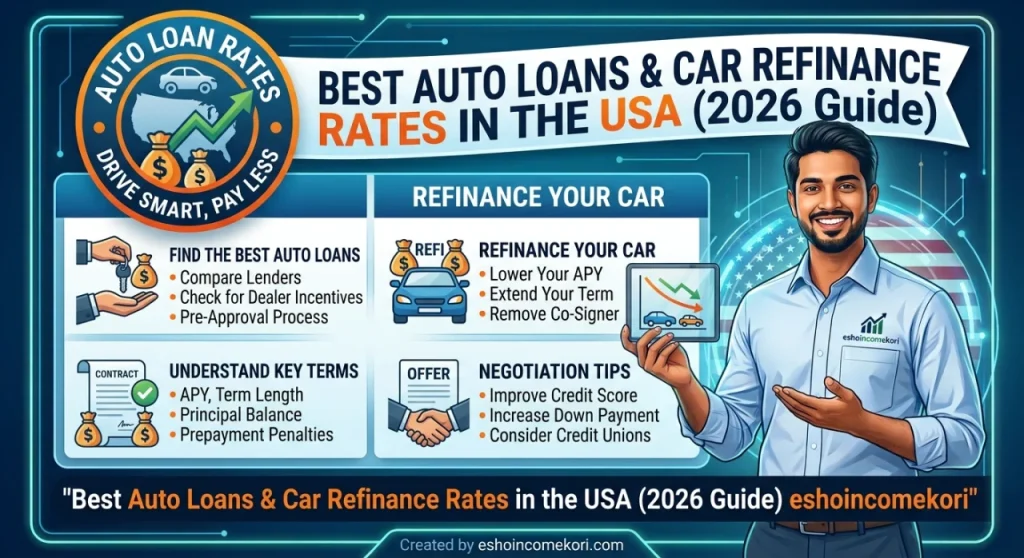
Best Auto Loans & Car Refinance Rates in the USA (2026 Guide)
Compare top auto loan and refinance rates for 2026. Review new and used car APRs, credit union discounts, subprime financing options, and LTV rules.
⚡ Google Discover Hook
With average auto loan rates hovering around 6.39% for new cars and 11.43% for used cars in 2026, walking straight into a dealership finance office without a pre-approval remains the most expensive way to buy a vehicle. Dealership markups often add 1% to 3% in hidden interest margins. Discover how military credit unions, online auto marketplaces, and direct lenders are offering rates starting as low as 3.39% to 5.44%, and how refinancing a subprime auto loan can save you over $2,000 in lifetime interest.
📖 Table of Contents
1. 2026 Auto Loan & Refinance Market Landscape
Vehicle financing in 2026 reflects a distinct split between captive dealership lenders (which use promotional APRs to move new inventory) and credit unions or direct banks (which offer the lowest everyday rates for used vehicles and auto refinancing).
  +--------------------------------------------------------------------------+
  |                   2026 AVERAGE AUTO LOAN BENCHMARKS                      |
  +--------------------------------------------------------------------------+
  | Metric                       | New Vehicles       | Used Vehicles        |
  +------------------------------+--------------------+----------------------+
  | Average Purchase Price       | ~$48,200           | ~$28,500             |
  | Average Loan Amount          | $43,925            | $27,070              |
  | Average Interest Rate (APR)  | 6.39%              | 11.43%               |
  | Average Loan Term            | 69.5 Months        | 67.7 Months          |
  | Average Monthly Payment      | $770               | $531                 |
  +--------------------------------------------------------------------------+
  Source: Experian State of the Automotive Finance Market (Q1-Q2 2026 Data)
2. Top Auto Loan & Refinance Lenders Compared
The table below compares leading national lenders across key auto loan metrics, including starting APRs, credit score thresholds, and maximum vehicle age/mileage restrictions.
| Lender | Loan Types Offered | Starting APR | Min. Credit Score | Max Vehicle Age / Mileage | Standout Advantage |
| PenFed Credit Union | New, Used, Refi | 3.39% | ~650 | 12 yrs / 125,000 miles | Rate discounts when using TrueCar buying service |
| Bank of America | New, Used, Refi | 5.44% | 660 | 10 yrs / 125,000 miles | Up to 0.50% Preferred Rewards discount |
| Capital One | New, Used, Refi | 5.70% | 600 | 10 yrs / 120,000 miles | Pre-qualify online via Auto Navigator with no credit impact |
| Caribou | Refinance Only | 4.49% | 600 | 12 yrs / 120,000 miles | Competes across a network of lenders for fair-credit refi |
| Autopay | New, Used, Refi | 4.29% | 580 | 11 yrs / 125,000 miles | Marketplace matching low credit scores with specialized credit unions |
| Chase Bank | New, Used, Refi | 5.94% | 660 | 10 yrs / 120,000 miles | Direct online application with fast dealership funding |
3. Auto Loan Rates by Credit Score Tier
Your credit score is the primary determinant of your interest rate. Lenders classify borrowers into five distinct credit tiers:
  +--------------------------------------------------------------------------+
  |              2026 AVERAGE APR BY FICO / VANTAGESCORE TIER               |
  +--------------------------------------------------------------------------+
  | Credit Tier         | Score Range | New Car APR      | Used Car APR      |
  +---------------------+-------------+------------------+-------------------+
  | Super Prime         | 781 - 850   | 4.55%            | 6.30%             |
  | Prime               | 661 - 780   | 6.23%            | 8.77%             |
  | Near Prime          | 601 - 660   | 9.67%            | 14.03%            |
  | Subprime            | 501 - 600   | 13.44%           | 19.42%            |
  | Deep Subprime       | 300 - 500   | 16.01%           | 21.77%            |
  +--------------------------------------------------------------------------+
  Source: Experian Automotive Finance Data
Pro Tip: Moving up a single credit tier (e.g., from Near Prime at 650 to Prime at 670) can cut used car interest rates by 5 percentage points, saving thousands over a 60-month loan term.
4. New vs. Used vs. Auto Refinancing
Understanding the structural differences between purchase loans and refinancing helps you select the correct strategy:
New Vehicle Loans
-
Why Rates Are Lower: New cars serve as stronger collateral because their market value is predictable and they carry manufacturer warranties.
-
Promotional Financing: Automakers frequently offer subsidized promotional rates (e.g., 0% to 2.9% APR for 36–48 months) for top-tier credit profiles.
Used Vehicle Loans
-
Why Rates Are Higher: Higher risk of mechanical failure and accelerated depreciation makes used cars higher-risk collateral for lenders.
-
Sweet Spot: 2- to 4-year-old certified pre-owned (CPO) vehicles often qualify for lower interest rates than non-CPO used cars.
Auto Refinancing
-
Best Use Case: If you accepted a high-interest loan at a dealership, or if your credit score has improved by 40+ points since buying the car, refinancing replaces your existing auto loan with a new, lower-rate loan.
-
Timing Rule: Refinance within 60 to 90 days of initial vehicle purchase, or once your new vehicle title has been properly registered by the DMV.
5. Understanding Loan-to-Value (LTV) & GAP Insurance
Loan-to-Value (LTV) represents the ratio of your total loan amount to the actual wholesale value (NADA or Kelley Blue Book) of the vehicle.
-
Standard Cap: Most lenders require an LTV of 100% to 125% or lower.
-
Negative Equity (“Underwater”): If you owe $25,000 on a vehicle worth only $18,000, your LTV is 138%. Many lenders will reject a refinance unless you pay down the $3,000 difference out of pocket.
Guaranteed Asset Protection (GAP)
If your car is totaled in an accident, standard auto insurance only pays the vehicle’s actual market value. GAP insurance covers the “gap” between insurance payout and your remaining loan balance. Always purchase GAP through a credit union or insurer ($200–$400) rather than a dealership ($800–$1,200).
6. Step-by-Step Guide: How to Lock the Lowest Rate
Follow this workflow to avoid dealership markup traps:
7. Real-World Case Study: Refinancing a 16% Dealer Loan
Profile
-
Borrower: Javier (Austin, TX)
-
Vehicle: 2023 Toyota Camry (Current Value: $22,000)
-
Original Loan: $24,000 financed at the dealer at 16.50% APR for 72 months (FICO score was 590 at purchase).
-
Current Status (1 Year Later): Credit score improved to 680 (Near Prime/Prime boundary). Remaining balance is $21,200 with 60 months left.
Refinance Strategy
Javier applied through Caribou and secured a refinanced auto loan via a regional credit union at 6.99% APR for 60 months.
  AUTO REFINANCE COST COMPARISON:
  -------------------------------------------------------------
  Original Loan Payment (16.50% APR): $524.80 / month
  New Refinanced Payment (6.99% APR): $419.65 / month
  Monthly Cash Flow Savings:          +$105.15 / month
  Remaining Interest (Original):      $10,288.00
  Remaining Interest (New Loan):      $3,979.00
  TOTAL NET SAVINGS:                  $6,309.00
  -------------------------------------------------------------
8. Frequently Asked Questions (FAQ)
What credit score do I need to get approved for an auto loan?
There is no absolute minimum credit score requirement. Subprime lenders approve borrowers with scores as low as 500–580, though interest rates will be higher (13%–21%). A score of 660 or higher unlocks competitive prime interest rates.
Is it better to get an auto loan from a bank or a dealership?
Securing a pre-approval from a bank or credit union gives you leverage. Dealerships can sometimes offer manufacturer-subsidized rates (0%–2.9%) on new vehicles, but they may also mark up standard bank interest rates to earn a profit margin.
How soon after buying a car can I refinance the auto loan?
You can refinance as soon as the vehicle title is registered with your state DMV and the current lender has established the account balance—typically within 30 to 90 days of purchase.
Does auto loan refinancing carry closing costs?
Most auto refinance lenders charge $0 in closing costs or application fees. However, you may need to pay a small state title transfer fee ($15–$75) to reassign the lien holder on your vehicle title.
আরো পড়ুন
- অনলাইন লোন সার্ভিস দিয়ে ইনকাম Incomeকরুন
- এফিলিয়েট Affiliate এবং ব্লগিং মার্কেটিং এর জন্যে কাজের ১০টি টুলস
- কিভাবে মাত্র ৫ মিনিটে logo লোগো তৈরি করবেন? ফ্রি লোগো ডিজাইন
- ফাইন্যান্স ও বিজনেস ব্লগ লিখে ইনকাম Income করুন
- স্ক্রিল Skrill– অর্থ লেনদেনের সহজ ও নিরাপদ পদ্ধতি
📄 JSON-LD Structured Data (FAQ Schema)
JSON
{
  "@context": "https://schema.org",
  "@type": "FAQPage",
  "mainEntity": [
    {
      "@type": "Question",
      "name": "What is the average auto loan interest rate in 2026?",
      "acceptedAnswer": {
        "@type": "Answer",
        "text": "According to Experian data in 2026, the average new car interest rate is 6.39%, while the average used car interest rate is 11.43%."
      }
    },
    {
      "@type": "Question",
      "name": "How much can refinancing an auto loan save?",
      "acceptedAnswer": {
        "@type": "Answer",
        "text": "Borrowers who refinance from a subprime rate (14%-18%) to a prime rate (6%-8%) typically save $75 to $150 per month and $2,000 to $6,000 in total interest over the life of the loan."
      }
    }
  ]
}